MAPA History

2026


2025

  • Augsburg University accepted its inaugural doctoral program class
  • MAPA Collaborates on the Treat Yourself First Campaign Treat Yourself First
  • Upon Tom Lehman’s retirement, MAPA contracted with Matthew Bergeron and Julia Page from Larkin Hoffman for lobbying services.


2024

  • Minnesota Academy of Physician Assistants changed its name to the Minnesota Academy of Physician Associates.
  • Article 22 of Minnesota’s omnibus health policy bill removed redundant language, thereby eliminating arbitrary limitations on PAs treating patients with mental illness.  This change reinforced PA’s roles in mental healthcare without unnecessary restrictions.
  • Minnesota became the 11th state to enact the Physician Assistant (PA) Licensure Compact, following Governor Tim Walz’s signing of HF 5247.  This compact allows licensed PAs to practice in participating states without obtaining multiple individual licenses, thereby enhancing healthcare access and workforce mobility
  • MAPA received the AAPA Constituent Outreach and Advocacy Award CO Outreach and Advocacy Award Recipient Strives to Empower PAs – AAPA
  • Leslie Clayton, PA-C appointed Speaker and VP of the Board of Directors, 2024-2026


2023

  • Elise Haupt, PA-C, became the first non-physician elected President of the Minnesota Society of Hospital Medicine.
  • MAPA awarded the first annual scholarship awarded to attend the AAPA Executive Leadership Conference


2022

  • The PA Harmonization Act updated statutory language by incorporating PA-related terms, eliminating supervision requirements, and aligning with the 2020 PA Modernization Act. 
  • MAPA expressed significant concerns about the negative impact of the Supreme Court decision in Dobbs v. Jackson Women’s Health Organization on the reproductive healthcare rights of our patients and the patient-PA relationship.


2021

  • MAPA was invited to participate as one of five panelists for the Minnesota Physician journal’s roundtable report titled, ‘Clinical and Non-Clinical Care Teams – Improving Interoperability’.  
  • MAPA President Jenifer Detert authored articles (12) on PA leadership, care delivery, and practice barriers. 
  • Leslie Clayton, PA-C appointed 2nd Vice Speaker 2021-2024


2020
   

  • The PA Modernization Act eliminated the physician supervision requirement, allowing a PA’s scope of practice and prescribing authority to be determined by their education, training, and practice agreement.
  • The CME Committee quickly pivoted to successfully transform the planned Spring CME event from in-person to virtual, due to COVID-19. The Fall CME event was also virtual. For the first time, CME offerings included both live and on-demand options.
  • The Mayo Clinic College of Medicine and Science in Rochester accepted its inaugural PA class.
  • Tom Pahl, PA-C, was appointed to the State Trauma Advisory Council 2020-2024


2019
   

  • Minnesota Legislation requires prescribers, including PAs, who have the authority to prescribe controlled substances, to complete at least two hours of continuing medical education on opioid prescribing best practices. This was only in effect from 2020 through 2022.
  • Leslie Clayton, PA-C appointed 2nd Vice Speaker 2019-2021


2018
 

  • Term limits on members of the PA Advisory Committee to the Board of Medical Practice were eliminated.

2017

  • Palliative Care Advisory Council was created with a mandated seat for a PA who is a member of the American Academy of Hospice and Palliative Medicine.
  • The Health Professionals Clinical Training Expansion Grant Program was established and specifically included PA programs. 
  • PAs were included in the list of qualified providers to perform face-to-face encounters for home health services.
  • Legislation was passed that allows physician assistants to perform a range of duties previously restricted to only physicians, including filing vital records with the Office of Vital Records and completing identification cards for people who need special diets for medical reasons.
  • The College of St. Scholastica in Duluth accepted its inaugural PA class.

2016 –  (40th MAPA Anniversary) 

  • Significant revisions to 147A were accomplished, including removing the PA-physician ratio and once again, replacing physician’s assistant with physician assistant in all statutes.
  • Temporary family care dwellings were defined (statute 394.307), and PAs were included in the list of professionals who can certify that a person is mentally or physically impaired, a.k.a requires assistance with two or more instrumental activities of daily living.


2015
   

  • Medical Assistance coverage for mental health services (statute 256B.0625, subdivision 28) was modified to allow PAs to bill in outpatient settings after they have completed 2,000 hours of clinical experience in the evaluation and treatment of mental health, consistent with their authorized scope of practice, as defined in section 147A.09, with the exception of performing psychotherapy or diagnostic assessments or providing clinical supervision.
  • Enabling legislation for Community Medical Response Emergency Medical Technicians was created. PAs are included on the list of professionals who can supervise their clinical training and develop a patient care plan under which the community paramedic can function.
  • Tracy Keizer, PA-C, co-authored “The Benefits of a Physician Assistant and/or Nurse Practitioner Psychiatric Postgraduate Training Program”, which was published in the April issue of Academic Psychiatry.


2014
      

  • Statutory language was changed to remove the apostrophe s:  from “physician’s assistant” to “physician assistant”.
  • The Pharmacy statute was modified as follows:
    • Include PAs as a professional with whom a pharmacist can have a protocol to administer influenza vaccines to all eligible individuals ten years of age and older, and all other vaccines to patients 18 years of age and older.
    • A Pharmacist can administer a vaccine pursuant to a valid, patient-specific order issued by a PA.
    • A Pharmacist may participate in the initiation, management, modification, and discontinuation of drug therapy according to a written protocol or collaborative practice agreement between one or more pharmacists and one or more PAs
  • The statute creating the medical cannabis registry program was created. PAs are included as health care practitioners who can certify that a patient has one of the listed qualifying medical conditions.


2013
      

  • The statute governing health plans in Minnesota was modified to include PAs in the definition of primary care provider.
  • PAs were added to the list of professionals who can verify that a hunter is physically disabled and thus eligible to use a swivel or otherwise mounted firearm or bow or any electronic or mechanical device to discharge a firearm or bow, as long as the participant is physically present at the site.
  • The Minnesota Department of Human Services report, The Role of Physician Assistants in Outpatient Mental Health Care, is presented to the Legislature. This report is not favorable for the practice of PAs in mental health.
  • Bethel University PA Program in Arden Hills accepted its inaugural class.


2012

  • Medical Assistance coverage for mental health services was modified:
    • Licensed physician assistants, who are supervised by a physician certified by the American Board of Psychiatry and Neurology or eligible for board certification in psychiatry, may bill for medication management and evaluation and management services provided to medical assistance enrollees in inpatient hospital settings, consistent with their authorized scope of practice, as defined in section 147A.09, with the exception of performing psychotherapy, diagnostic assessments, or providing clinical supervision.
    • Payments for mental health services covered under the medical assistance program that are provided by physician assistants shall be 80.4 percent of the base rate paid to psychiatrists.
  • St. Catherine University in St. Paul accepted its inaugural PA class.
  • Tracy Keizer, PA-C, wrote “Five Things Physicians Should Know About Physician Assistants”, which was published in the November issue of Minnesota Medicine.
  • Jackie Osterhaus, PA-C, was appointed to the Minnesota Rural Health Advisory Committee 2012-2016.


2011
      

  • Mary Fargen, PA-C, was awarded the Humanitarian Award at the PAramount dinner during the annual AAPA meeting.
  • Enabling legislation for Community Paramedics was created. PAs are included in the list of professionals who can supervise clinical training for them and in the list of professionals who can develop a patient care plan under which the community paramedic can function.
  • Modifications to hunting statutes were made that allow PAs to:
    • Verify that a hunter has visual impairment and thus is eligible to obtain a permit to use a muzzleloader with a scope to take deer during the muzzleloader season.
    • Verify that a hunter has a permanent physical disability that makes them eligible to obtain a permit to discharge a firearm or bow and arrow from a stationary motor vehicle during hunting season.
    • Verify that a hunter is temporarily or permanently disabled and unable to hunt or fish by archery for a minimum of two years, thus making them eligible to obtain a permit to take big game, small game, or rough fish with a crossbow.


2009

  • MAPAs Technical Amendment Bill passed. It can be found in the 2009 Session Law Chapter 159. The components of the Bill included:
    • Changed PA registration to licensure
    • The Practice Setting Description is changed to a Notice of Intent to Practice.
    • The Supervisory Agreement is changed to a Delegation Agreement.
    • Allowed up to five PAs per physician, with board discretion to allow more
    • Added PAs as examiners for 72-hour holds
    • The duties of the Physician Assistant Advisory Council were expanded.
  • The Respiratory Care Practitioner statute was updated to include PAs to the list of professionals who can order respiratory therapy.
  • MAPA was the runner-up for AAPA Constituent Organization Awards of Achievement, Medium Chapter.

2008      

  • Health Care Reform legislation signed by Governor Pawlenty emphasized PA use in primary care. PAs are defined in the law as a “personal clinician” along with Physicians and Advanced Practice Nurses.
  • Wanda Andrews, PA-C: Represented MAPA on the Health Care Reform Review Council.
  • Dave Barlow, PA-C: Served on the Healthcare Workforce Shortage Study Group.
  • Lisa Benish, PA-C: Participated in the Health Care Homes Criteria Work Group.
  • Brooke Hovick, PA-C: Contributed to the Total Knee Replacement Basket of Care Work Group.
  • “Physician Assistant Practice in Minnesota – Providing Care as Part of a Physician-Directed Team”, written by Bev Kimball, PA-C, and Walt Rothwell, PA-C, published in the May issue of Minnesota Medicine.
  • Peter Lindbloom, PA-C, was appointed to the State Trauma Advisory Council 2008-2016.
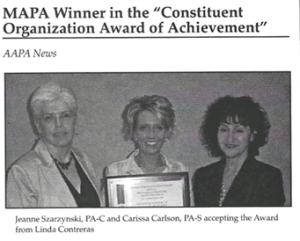
  • MAPA received the AAPA Award of Achievement for a medium-sized chapter.

2007      

  • MAPA was a sponsoring organization for the Freedom to Breathe Act.
  • MAPA joined the Minnesota Alliance for Patient Safety (MAPS) coalition.
  • MAPA Reimbursement Committee met with PreferredOne to discuss concerns about coverage for physician services provided by PAs.
  • MAPA Received AAPA Award of Excellence for medium-sized chapters.

2006      

  • PAs added to a bill offering liability protection for providers serving civilly committed or incarcerated individuals. 
  • MAPA met with major insurers (HealthPartners, Blue Cross/Blue Shield, Medica) to address PA service coverage concerns. 
  • Augsburg PA Program launched a High School Curriculum Project.
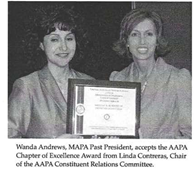
  • MAPA received the AAPA Chapter Excellence Award for medium-sized chapters.

2005

  • MAPA introduced legislation to remove the “at least weekly” provision on review of prescriptive practice. The new requirement is that “this review must take place as outlined in the internal protocol”. In addition, that legislation removed the requirement for phone numbers on prescriptions written by PAs (bringing prescription information generated by PAs in line with that of physicians and nurse practitioners) and eliminated the requirement that the supervising physician’s name be included.
  • Tom Hock, PA-C, was appointed to serve on the newly created Minnesota State Trauma Advisory Council from 2005 to 2008. 
  • Due to health concerns, OJ Doyle needed to resign as our lobbyist, and MAPA contracted with Tom Lehman


2004
      

  • MAPA introduced legislation that was subsequently enacted:
    • separate employment from the process of obtaining permanent registration.
    • permit supervising physicians to delegate the performance of radiographic procedures.

2003

  • MAPA introduced legislation authorizing supervising physicians to delegate the authority to sign disability parking permits. The legislation also permitted psychiatrists to delegate the signing of 72-hour hold documentation to PAs practicing with them in psychiatric facilities.
  • Clover Schultz, PA-C, is elected Chair of the Minnesota Rural Health Advisory Committee.
  • MAPA received the SAAAPA constituent organization award
  • MAPA received the AAPA Chapter Excellence Award for large chapters.

2002

  • After years of lobbying, Medica decided to credential PAs (they had previously declined to credential anyone other than “independent licensed practitioners”).
  • Legislation was enacted to provide malpractice coverage for individuals delivering voluntary healthcare services, and PAs were included among those covered.
  • Assurance was received from Blue Cross-Blue Shield that they will cover “medication management” services provided by PAs.
  • MAPA contracted with The Harrington Company for administrative services.

2001 – MAPA’s 25th Anniversary

  • MAPA successfully introduced legislation to eliminate the statutory requirement for infection control CME (since no other profession had such a requirement).
  • Weekly prescriptive reviews replaced daily retrospective reviews, allowing more flexible supervisory agreements.
  • MAPA received the AAPA Constituent Award of Excellence for a medium chapter

2000      

  • MAPA contracts with OJ Doyle for lobbying services.
  • OJ’s daily presence at the Capitol provided increased exposure and recognition.
    • PAs are allowed to staff specialized ground transport services.
    • PAs were added to the list of those who can provide school bus driver physicals
    • Term limits for the PA Advisory Council members were added.
    • Added PAs to the Medicaid provider list and clarified DOT exam authority.
  • MAPA is awarded the AAPA Constituent Organization Award of Excellence for a large chapter

1999

  • United Health Care, the Medicare Part B Carrier for Minnesota, decided that PAs cannot provide upper-level Evaluation & Management office visits (99204, 99205), emergency department visits (99284, 99285), and nursing home visits (99322, 99323). MAPA worked with AAPA and our Federal Legislators, and by the end of the year, this interpretation of Medicare law was reversed once again, allowing PAs access to these E & M codes.
  • MAPA reintroduced “The Disaster Bill,” (originally introduced in 1997) and it passed
  • The Minnesota DOT ruled that PAs could sign DOT certificates if their supervising physician provided a letter with each certificate, explicitly delegating the authority to conduct the exam.
  • MAPA received the AAPA Chapter Excellence Award for medium-sized chapters.
  • MAPA created an intranet site to share information among members.
  • The Student Scholarship Committee held the first annual silent auction fundraiser.
  • The Student Relations Committee organized the first annual Challenge Bowl.
  • Clover Schultz, PA-C, was appointed to the Minnesota Rural Health Advisory Committee, 1999-2003.

1998      

  • Grassroots’ lobbying efforts successfully added PAs to professional corporations.
  • The MMA House of Delegates discussed narrowing the definition of who can perform pre-participation sports exams. MAPA was invited to present testimony that led to the inclusion of PAs in the definition.
  • The Minnesota Department of Transportation determined that PAs do not have the statutory ability to perform DOT exams.
  • The Minnesota Department of Health required PA supervisory agreements to authorize the explicit ordering of radiographic exams.
  • Steve Harr, PA-C, was elected President of the Minnesota Rural Health Association.
  • MMA invited MAPA representatives to be regular guests on its Committees on Legislation, Ethics and Medical Legal Affairs, and Medical Practice and Planning.
  • MAPA received the Third Place AAPA Constituent Organization Public Education Award


1997
      

  • MAPA introduced legislation that included the “Disaster Bill” and removal of the sunset on the PA Advisory Council.  The “Disaster Bill” failed to pass.
  • On a Federal level, the Balanced Budget Act raised the reimbursement level for ALL physician services provided by PAs to 85% of the physician rate.
  • Steve Scott, PA-C was appointed to the Minnesota Rural Health Advisory Committee 1997-1998.

1996  – MAPA’s 20th Anniversary

  • The scholarship committee awarded $2300 to deserving students.
  • MAPA membership totaled 225: 161 Fellows, 12 Sustaining, 38 Students.

1995

  • Since the inception of the original Rules (1984), the profession was under the jurisdiction of the Department of Health, with the regulation done by the Board of Medical Practice. In 1995, the Department of Health decided to transfer the profession to the Board of Medical Practice.
  • The BMP introduced legislation to move the Rules to Statute. In that process:
    • The delegated ability to prescribe controlled substances was gained, and
    • The requirement for on-site supervision was eliminated.
  • The article “A Measure of Independence” was published in the July 1995 issue of Minnesota Medicine (Volume 78), examining the roles of PAs and NPs with insights from MAPA and various PAs. The issue also featured the editorial “Beating the Odds” by Steve Rapatz-Harr, PA-C.
  • Augsburg University in Minneapolis welcomed its inaugural PA class in May.
  • Mayo-Gundersen-University of Wisconsin-LaCrosse welcomed its inaugural PA class in September
  • MAPA established a student scholarship committee.
  • The first MAPA website was launched.


1994

  • MAPA, together with the MNA, introduced legislation to clarify questions surrounding dispensing.
  • The Health Professional Services Program (HPSP) was created by the Legislature, and MAPA has a statutorily guaranteed seat on the advisory council for HPSP.
  • At a town hall meeting at HCMC, Senator Wellstone recognized PAs as vital to the future of healthcare, consistently including them in his definition of healthcare providers. Tamsen Morgan represented Minnesota PAs at the event.

1993      

  • MAPA held the first PA Day on the Hill (as opposed to Breakfast or Lunch with Legislators). In addition to discussing PA-centric issues, we actively lobbied for a prohibition on smoking in family day care centers.
  • Steve Rapatz-Harr wrote “What Every Clinic Wants to Know About Physician Assistants” for publication in Minnesota Medicine.
  • The Minnesota Department of Human Services increased reimbursement for Medicaid services provided by PAs from 65% to 90% of the physician rate.


1992
      

  • Even though the legislation was passed in 1990, it took until 1992 for the rules to be adopted that finally allowed PAs to have delegated prescriptive privileges.
  • Augsburg College developed a proposal for a PA program.
  • MAPA received the AAPA Membership Growth Award for medium-sized chapters


1991
      

  • MAPA successfully advocated for PAs to be included in loan forgiveness programs.
  • Mark Helgeson’s article PAs Speak Out was published in Hospital News.
  • The Minnesota Medical Association (MMA) established an Interspecialty Council, appointing Gary Howe, PA-C.
  • Governor Carlson formed the Rural Health Advisory Committee, with Mark Zellmer, PA-C, appointed as a member.
  • MAPA won first prize in the medium-sized chapter category of AAPA’s Public Education Scrapbook Competition.

1990

  • MAPA accomplished the “five-year plan” in record time! On April 26, 1990, legislation was signed into law to allow delegated prescriptive privileges.
  • MAPA allocated funds to support efforts to establish a PA program in Minnesota. 
  • MAPA joined the Minnesota Rural Health Coalition.
  • Don’t Call Me Doctor, featuring Mark Helegson, PA-C, Bev Frye, PA-C, and Steve Wandersee, PA-C, appeared in the September issue of Minnesota Medicine volume 73, issue 9.

1989

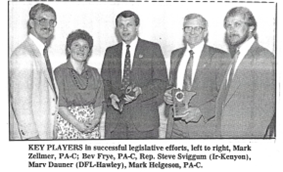
  • MAPA held its first-ever Legislative Breakfast, attended by 31 PAs and 20 Legislators.
  • Work continued on the “five-year plan” by surveying pharmacists and supervising physicians.
  • Department of Health Rules (which governed how a PA can practice) were modified to include ordering therapeutic procedures (previously it had only included performing them) and changed the on-site supervision from “at least 8 hours a week” to “a minimum of 20% of the time the PA is providing patient services”.
  • MAPA initiated having a MAPA member in attendance as an observer at Board of Medical Practice meetings.

1988      

  • MAPA created a Legislative Committee and began formulating a five-year plan to acquire delegated prescriptive privileges.
  • The tradition of MAPA’s Past Presidents’ Award (initially called the “Outstanding MAPA Member” award) is initiated and given to Cindy Lundgren and Jennifer Rapatz.
  • MAPA established an official MAPA phone number through a secretarial service.

1987

  • The Board of Medical Practice began registering Minnesota PAs.
  • October 6, 1987, marking the 20th anniversary of the first PA class graduation from Duke University, was designated “PA Day.” MAPA secured official PA Day proclamations from Governor Perpich, St. Paul Mayor Latimer, and Minneapolis Mayor Fasser.
  • On the national level – Medicare decided to cover physician services provided by PAs in a nursing home at 85%, in a hospital at 75%, and for assisting at surgery at 65%. 


1986

  • MAPA won an AAPA award for increasing AAPA membership.


1985
      

  • Minnesota Rules 5600.2600 to 5600.2665 were passed, which governed the registration and practice of physician assistants in Minnesota. These rules outlined the requirements for PA registration, defined the scope of practice, and detailed the supervisory relationships between PAs and physicians. They also established the Physician Assistant Advisory Council, specifying its membership and duties.
  • The first PA Advisory Council members were appointed: Steve Scott, PA-C; Steve Wandersee, PA-C; and Bob Adams, OPA. Over the next two years, the Council and the Board of Medical Practice staff developed the necessary forms for implementing the new rules.


1980

  • The Minnesota Insurance Commissioner mandated that Blue Cross Blue Shield reimburse services provided by PAs.     


1978
      

  • The first public forum on PA credentialing was held, leading to the creation of the Physician Assistant Technical Advisory Group. Work also began to develop rules to regulate PAs.
  • This was a multi-year process involving a 75-page “Statement of Need and Reasonableness” and innumerable rewrites of the eventual Rules.


1977
      

  • Change of name from Minnesota Society of Primary Care Physicians Assistants to the Minnesota Academy of Physician Assistants
  • MAPA was formally incorporated by Don Reed, June Randall, and Tom Phannenstein.

1976      

  • Efforts to credential PAs began through the Minnesota Department of Health, Division of Health Manpower, Allied Health Credentialing Advisory Committee. 
  • The first organizational meeting of the Minnesota Society of Primary Care Physician Assistants was attended by 24 PAs. The founding members of the Board of Directors were Gary Borrell, Cindy Lundgren, Tom Pfannenstein, Barry Radin, June Randall, Don Reed, Dennis Vandermay, and Michelle Witt. There were 57 PAs known to be in Minnesota at the time.


1973
      

  • The St. Cloud PA Program began. Two classes graduated (1975 & 1976), but the program did not receive accreditation.


1971
      

  • A bill was introduced in the Minnesota Legislature to create a system of certification for “physician’s assistants” as well as one to allow physicians to “delegate tasks to aides and assistants”. Both bills failed.  This was prior to MAPA’s inception; therefore, we do not know who sponsored them.
  • The first formally trained PA associated with MAPA began practicing in Minnesota. Bob Freeman, a graduate of the Duke PA Program, practiced pediatrics in the Twin Cities for his entire career.  In 1975, he and three pediatricians began a general pediatric practice in North Minneapolis.

1969

  • The first formally trained PA began practice in Minnesota.  Tom Godkins, 1969 graduate of the Duke PA Program, joined Mayo Clinic and stayed for a few years.  He was not affiliated with MAPA.